“I will descend the slope very quickly and roll down I don’t know where, wrapped in many bad pastel drawings”: Or, Matter and Ground in the Work of Degas
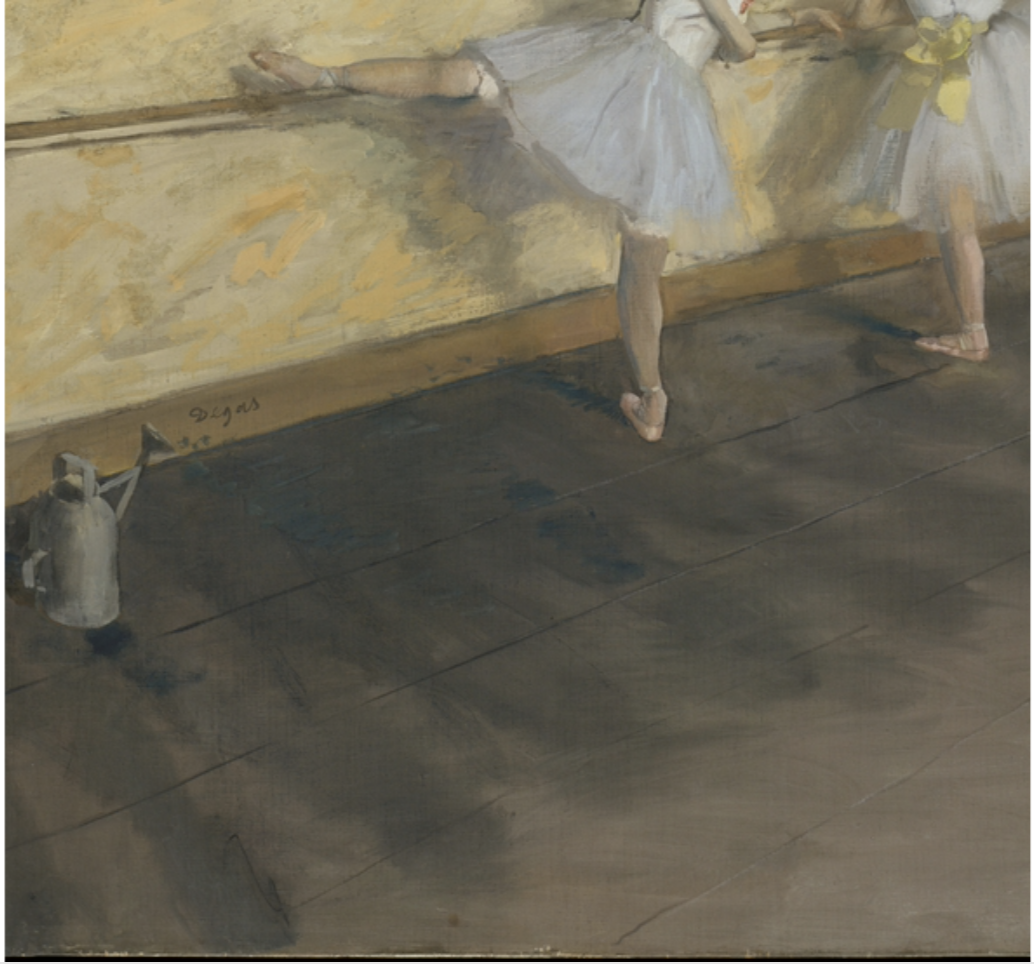
“Where has the time gone when I thought I was strong, when I was full of logic, full of projects? I will descend the slope very quickly and roll down I don’t know where, wrapped in many bad pastel drawings.” So wrote Edgar Degas in a letter to a close friend in 1884, the image of him tumbling down a hill intended to convey his sense of professional and personal despair. That Degas chose this particular metaphor is entirely in keeping with the pivotal role that the representation of weight, gravity, ground, and equilibrium played in his practice. While his ballet and equestrian pictures have long been understood as expressions of his attraction to the fashionable spectacles of his day, this talk will reframe his rendering of these motifs, among others, in part as meditations on the relationship of bodies to the ground beneath them.
During Edgar Degas’s lifetime, certain friends, colleagues, and critics perceptively identified his propensity for technical and material experimentation—using an especially wide range of media and techniques, manipulating his materials in unusual ways, and combining multiple media in a single work—as a central component of his practice. Nevertheless, more than a century after the artist’s death, there is still a great deal left to understand about the significance and conceptual sophistication of his investment in artistic process. Positioning Degas’s experimentations in the context of his equally important but long-overlooked investigation in his work into the physical and material qualities of the world around him reveals remarkable intersections between some of his best-known subjects and the materials, processes, and bodily gestures involved in the production of his pictures.
What emerges is an understanding of Degas’s interest in testing the representational possibilities of his materials and techniques, in devising strategies for evoking the phenomena of weight and gravity in his pictures, and in identifying motifs that point to the conditions of his pictures’ making. A persistent impulse to rethink representation in material terms, in which he viewed the matter of art in light of its capacity to convey the heft and substance of the world, and his sustained focus on the relationship of bodies to the terrain beneath them drove both how Degas made his pictures and his attachment to some of his most celebrated subjects.
Biography
Michelle Foa is associate professor of nineteenth-century European art in the Art Department of Tulane University. Her first book, Georges Seurat: The Art of Vision, was published in 2015 by Yale University Press. Her second book, Edgar Degas and the Matter of Art, is under contract with Yale, and an article drawn from that material published in The Art Bulletin was awarded the Nineteenth-Century Studies Association Article Prize in 2022. Other articles on the artist are forthcoming in the journals Art History and West 86th. Last year, she co-curated the exhibition “Edgar Degas: Multi-Media Artist in the Age of Impressionism” at the Clark Art Institute, which focused on the artist’s innovative use of a wide range of materials and techniques and his complicated relationship to Impressionism. She is co-organizing a workshop this summer on nineteenth-century paper at the American University of Paris and a symposium next spring at the Barnes Foundation. In addition, she is co-editing with Carol Armstrong a special issue of West 86th titled “Earthbound: Gravity/Figure/Ground” that will include the work of 20 authors and be published next year.
Her work has been supported by numerous fellowships and grants, including from the Center for Advanced Study in the Visual Arts at the National Gallery of Art, where she was a Samuel H. Kress Senior Fellow, the Sterling and Francine Clark Art Institute, where she was a Francis Gould Foundation Fellow, the National Endowment for the Humanities, and the Institut national d’histoire de l’art, where she will be a visiting scholar in June.
She is Vice President of the National Committee for the History of Art and serves on the Board of Directors of the Association of Historians of Nineteenth-Century Art as the organization’s Programs Chair.
 Home
Home 