River of Words: Paper, Water, Zinc
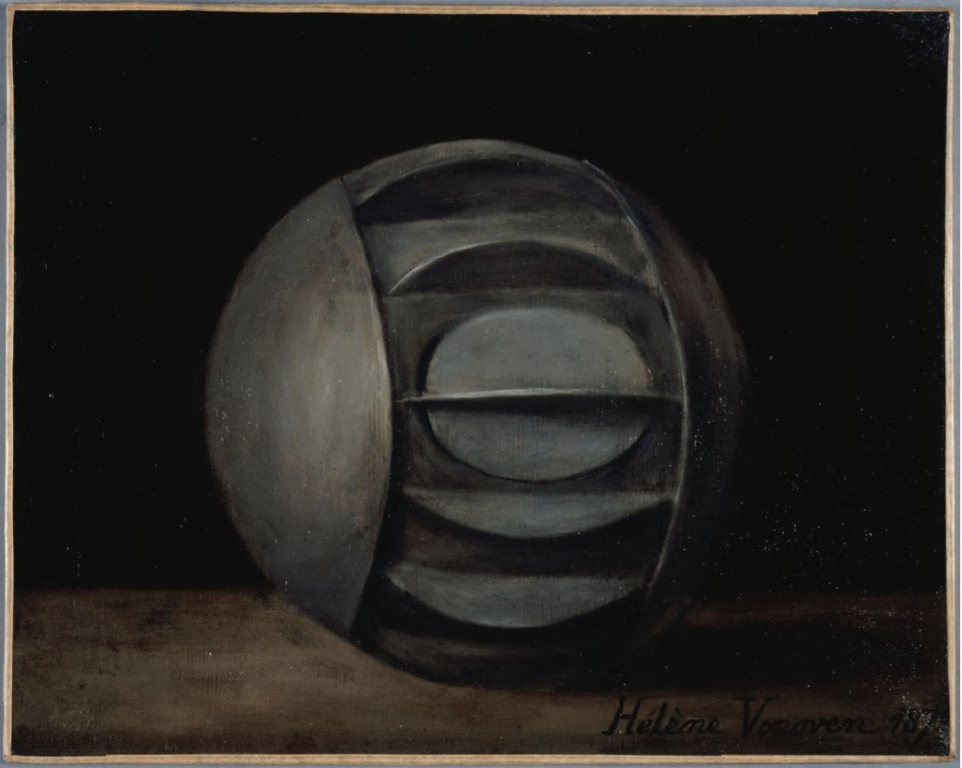
In 1870-1871, during the Siege of Paris, several ways to communicate into the city were developed. Famously, these included messages sent by pigeon and by balloon. Less well known are the attempts to send letters underwater into the besieged city. Letters were encased in specially constructed zinc spheres—known as boules de Moulins—which were dropped into the Seine. The hope was that the river’s stream would carry them into Paris, where they might be retrieved in nets. The system failed—none of the boules were found before the end of the siege and the Paris Commune that followed. Yet for years later, boules de Moulins were discovered, as far north as the Normandy coast and in the English Channel, disgorging their contents upon retrieval: mournful and anxious letters written by those exiled from the city and worried about family and friends. Many boules have not been found and are presumably still making their slow passage through France’s waterways. Taking its cue from an enigmatic painting of a boule de Moulins, by Hélène Vonoven, this paper will consider how the aleatory migration of these objects might have something to tell us about materiality in times of crisis. Focusing in particular on paper, water, and zinc, I ask how such materials were central to technologies of communication, memory, and representation in nineteenth-century France.
Biography
Richard Taws is Professor and Head of the Department of History of Art at University College London, where he specialises in eighteenth-and nineteenth-century visual culture. Much of his work has been on printed images in times of revolution, and on the intersection of art history with histories and theories of science, media, and technology. He is author of Time Machines: Telegraphic Images in Nineteenth-Century France (MIT Press, 2025) and The Politics of the Provisional: Art and Ephemera in Revolutionary France (Penn State University Press, 2013). As a member of the ‘Multigraph Collective’, he co-authored Interacting with Print: Elements of Reading in the Era of Print Saturation (University of Chicago Press, 2018). He is co-editor of Time, Media, and Visuality in Post-Revolutionary France (with Iris Moon; Bloomsbury, 2021) and Art and Technology in Early Modern Europe (with Genevieve Warwick; Wiley, 2016). The recipient of fellowships from the Getty, Bard Graduate Center, British Academy, Leverhulme Trust, and Institute of Advanced Study, Princeton, he was awarded a Philip Leverhulme Prize in 2012. Richard’s writing has appeared in Grey Room, The Art Bulletin, Art History, Oxford Art Journal, Sculpture Journal, Perspective, Cabinet, Nonsite, Journal of Visual Culture, RES: Anthropology and Aesthetics, and the London Review of Books, among other places, and he is an editor of Oxford Art Journal.
 Home
Home 